 |
| |
|
To ensure delivery
of NursingCenter eNews
to your inbox, please add, [email protected]
to your address book
|
|
| July
2, 2009 |
| Dear
Subscriber,
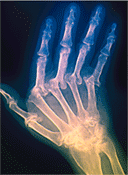 July
is Juvenile
Arthritis Awareness Month. The Arthritis
Foundation defines juvenile arthritis as “any form
of arthritis or arthritis-related condition that develops
in children or teenagers who are less than 18 years of age.”
They report that approximately 294,000 children under the
age of 18 are affected by pediatric arthritis and other rheumatologic
conditions. July
is Juvenile
Arthritis Awareness Month. The Arthritis
Foundation defines juvenile arthritis as “any form
of arthritis or arthritis-related condition that develops
in children or teenagers who are less than 18 years of age.”
They report that approximately 294,000 children under the
age of 18 are affected by pediatric arthritis and other rheumatologic
conditions.
The most common form of
arthritis in children is juvenile rheumatoid arthritis. While
it is understood to be an autoimmune disease, its exact cause
is not known. The most common features of this disease are
joint inflammation, joint contracture, joint damage, and change
in growth. Some children may complain of joint stiffness following
rest or a decreased activity level and weakness in muscles
around involved joints. Diagnosis can be difficult and may
occur only after other disorders have been ruled out.
Learn more by exploring
the articles in More Resources. Also, don’t miss our
next enewsletter about transplant
issues, along with the latest articles and
CEs.

Lisa Bonsall, MSN, RN, CRNP
Clinical Editor

Find NursingCenter.com on Facebook
|
 |
|
|
  What
is ahead in the United States with regard to influenza A(H1N1)? Review
several possibilities foreseen by experts in influenza pandemics by reading
EMERGING
INFECTIONS: Influenza A (H1N1): A Wake-Up Call. What
is ahead in the United States with regard to influenza A(H1N1)? Review
several possibilities foreseen by experts in influenza pandemics by reading
EMERGING
INFECTIONS: Influenza A (H1N1): A Wake-Up Call.
AJN, American Journal of Nursing
Discover the benefits of an automated
time and attendance system by examining TECH
UPDATE: An Automated Solution for Managing Your Workforce.
Nursing Management
Learn about 2 new scientific statements
from the American Heart Association in Heart
Failure: An Update. The first addresses prevention of heart
failure and the second describes methods to reduce the risk of hypertension
in the home healthcare setting.
Home Healthcare Nurse
Browse our Recommended
Readings about the use of mirrors in critical care nursing,
non-Hodgkin's lymphoma, tips and strategies for managing delirium, and
more.
New Patient Education collection!
This collection from our journal library has been selected and reviewed by NursingCenter’s Clinical Editor, Lisa Bonsall, MSN, RN, CRNP, to provide you with reliable tools for educating your patients about common disorders and their treatments. Purchase any of our patient education articles for just $1.99 each!
View our Patient Education Collection now! |

|
| 
Catheter-Associated UTI Knowledge Center: Improving Practice, Improving Outcomes
Catheter-associated UTI can seriously hinder your patient's recovery and add days to their hospital stay. Recent changes in Medicare reimbursement related to hospital-acquired, catheter-associated UTI has become an issue for nursing staffs. Learn strategies to prevent and treat UTI in your patients through free CE credit, webcasts and more...
Visit this Knowledge Center Now.
|
 |
| Read
the articles in the latest Featured
Journal  online only on NursingCenter. The Featured Journal gives you the
opportunity to get acquainted with the kind of coverage and clinical
information it has to offer. Get to know our journals. The
current Featured Journal is...
online only on NursingCenter. The Featured Journal gives you the
opportunity to get acquainted with the kind of coverage and clinical
information it has to offer. Get to know our journals. The
current Featured Journal is...
|
|
 |
|
 Educate
your patients about how to treat severe sunburn: Educate
your patients about how to treat severe sunburn:
- Drink plenty of water.
- Apply a cool, wet cloth to the
area three or four times a day or take a cool bath.
- Take acetaminophen (Tylenol) as
directed.
- Don't break blisters. If they
break on their own, wash the area two to three times a day with soap
and water and lightly cover it with gauze.
- Don't use first-aid creams or
sprays.
- Stay out of the sun.
- If you have eye pain or feel confused
or dizzy, call 911 or get to the nearest hospital emergency department.
Read more in PATIENT
EDUCATION: Severe Sunburn.
|

|
- A generic form of Plan B
has been approved for women 17 years of age and younger, by prescription
only.
- Nucynta (tapentadol)
50, 75, and 100 mg immediate-release tablets are now available for the
relief of moderate to severe acute pain in patients 18 years of age
and older.
See
more drug news.
|
|
|
--SPONSORED LINKS-- |
|
|
Advance your career
with an online degree
Bring quality care to your organization with an online BSN or Patient Safety
degree from the University
of Illinois. |
|
|
|
|
|
|
|
|
|
|
|
|
| |
|
|
|
|
Email
 this
NursingCenter eNews
to your colleagues and invite them to join
now.
They, too, will receive great content as well as free articles and discount
offers available only to subscribers. this
NursingCenter eNews
to your colleagues and invite them to join
now.
They, too, will receive great content as well as free articles and discount
offers available only to subscribers.
Want to make sure that you keep receiving
NursingCenter eNews?
Be sure to add [email protected]
to your address book!
NursingCenter respects your privacy
and will not share your information with other companies or organizations
without your permission. View our Privacy
Policy.
If you no long wish to receive NursingCenter
eNews, click on the
"Unsubscribe" link above.
Forgotten your username or password?
Please contact Customer Service at [email protected].
http://www.nursingcenter.com
Copyright © 2009 Wolters Kluwer Health | Lippincott Williams &
Wilkins. All rights reserved.
323 Norristown Rd., Suite 200, Ambler, PA 19002 |



 Do
nurses and physicians work together effectively? Find out what residents
think by reading
Do
nurses and physicians work together effectively? Find out what residents
think by reading